Mahima Shastry
01 / The project 15 min read

Atlas

Delegate the work. Keep the judgment.

ATLAS is a control center for supervising AI agent work to inspect the plan, review consequential actions, and recover useful work when execution stops.

View tutorial/prototype
My role
Product direction, information architecture, interaction design, UX writing, visual direction and prototype review. Implementation used AI-assisted coding in Codex.
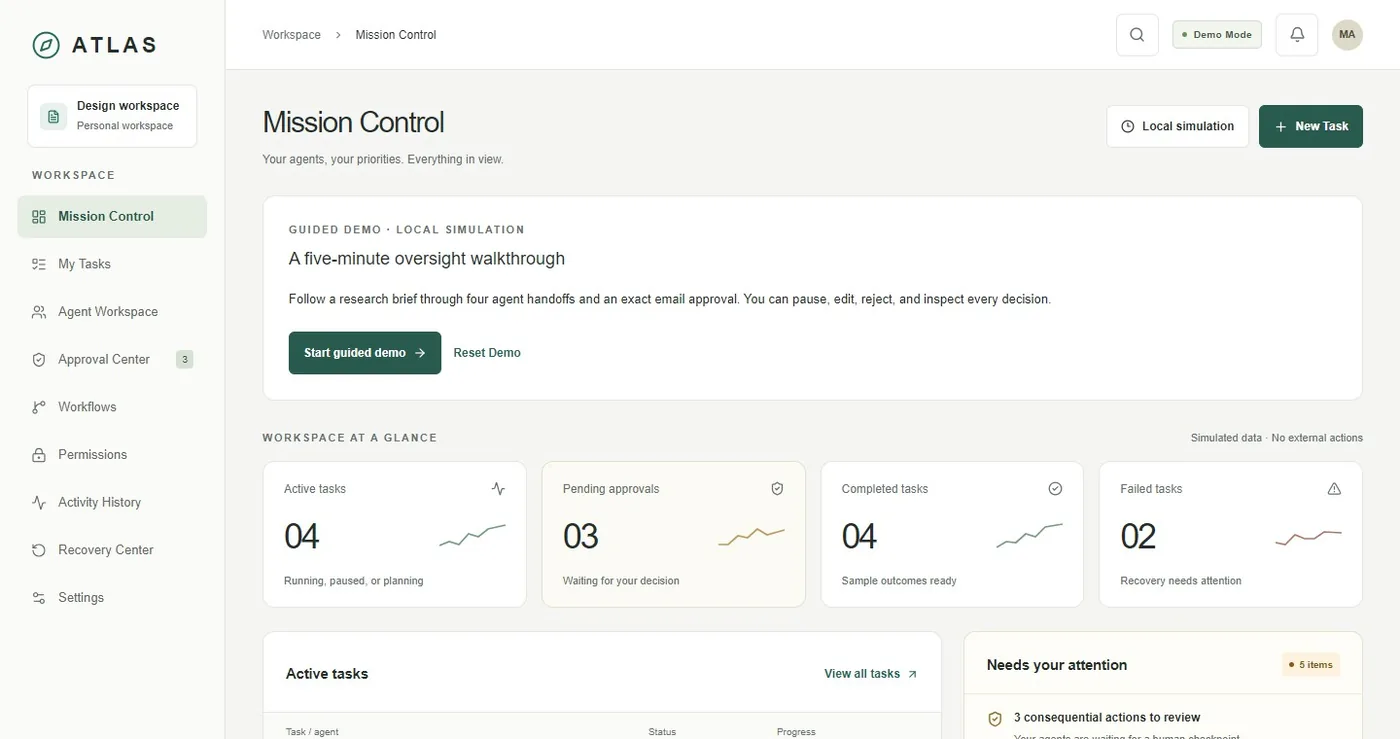
Atlas prototype
02 / The problem

The difficult part is the handoff.

The scenario

A product lead asks an agent to compare Northstar, Relay and Fieldwork, prepare a report, and draft an email for eight reviewers. These products, sources and recipients are fictional. The scenario pushes the question: what should the person know before sharing the result?

In ATLAS, each agent is a simulation with a particular responsibility.

Term to know: An artifact is a saved piece of work, such as extracted notes, a comparison or a report.

Handoff riskQuestion the interface must answer
Unclear scopeWhat will happen before I give up control?
Vague consentWhich content goes to which recipients, and can it be recalled?
Changing contentDoes my earlier approval still apply after an edit?
Interrupted executionWhat stopped, what survived, and where can I resume?
The design opportunity:

Make scope, ownership and the next human decision visible throughout delegated work.

An assumed risk journey

Brief the system > delegate > lose context > decide whether to intervene > reconstruct interrupted work.

What I could investigate within the constraint

With no paid services or live integrations, I focused on the interaction contract - What the user can

  • Inspect
  • Authorize
  • Pause
  • Reject
  • Recover.
03 / Secondary research

Start with what the evidence supports.

Published guidanceInterpretation for ATLAS
Microsoft / CHI 2019 [1] Human-AI interaction guidance addresses capability clarity, correction and user control.Expose the fixed plan and available interventions. Test whether a user can predict what will happen next.
Google PAIR [2] Control should fit the task; users need ways to adjust outputs and understand what their feedback changes.Keep edit, reject and clarification distinct. A local approval changes this proposal's state; it does not train a model.
NIST AI RMF 1.0, Appendix C [3] Human oversight roles and responsibilities need explicit definition; outcomes depend on context.Name the specialist responsible for each stage and the person responsible for each consequential decision.

Synthesis: three questions worth testing

Scope:can a person explain the plan before it runs?
Consent:can they identify the exact action they are authorizing?
Recovery:can they tell completed work from work that still needs to run?
04 / Empathize

Two roles. Different reasons to intervene.

These provisional personas define whom I would recruit and what I would investigate. They are role hypotheses.

Product lead

Job to support. Delegate a comparison, assess its report and decide whether to share it.

Assumed need. Inspect scope, sources, recipients and unresolved questions without watching every stage.

Question to test. Does the lead need all recipients and the full payload together, or a different review sequence?

Operations reviewer

Job to support. Set task boundaries and investigate work that has stopped.

Assumed need. Distinguish prepared, approved, blocked and completed work and finally find a justified next step.

Question to test. Can the reviewer explain why retry is unavailable and what must change before it becomes eligible?

The shared job

Help me delegate the work while keeping enough context to make the decisions that remain mine.

The lead's decision is about the content and its reach.

The reviewer's decision is about execution and recovery.

ATLAS connects both to the same task, so approval, permissions, saved work and history describe one underlying state.

What would change these personas

I would recruit people who already delegate multi-step knowledge work, ask them to walk through a recent task, and compare their actual responsibilities. If one person owns both roles, I would test whether the separate views help or add navigation.

05 / Define

Make the transfer of control explicit.

How might we help knowledge workers supervise delegated work, make informed decisions before consequential actions, and recover without losing completed work?

I translated the four handoff risks into interaction requirements. These criteria specify what the prototype must do.

How might we...Design responseBehavior to verify
Show the next action before it happens?An inspectable plan, stage ownership and optional plan checkpoint.A requested plan checkpoint holds execution with zero outputs.
Keep consent attached to exact scope?Consequence Preview with recipients, content, shared data and reversibility.Every simulated communication requires review and approval of the current revision.
Grant autonomy without granting blanket consent?Task-specific permissions, checked separately from exact approval.A revoked permission blocks the next affected operation.
Make failure resumable?Save work per stage and expose retry eligibility.A failed comparison retains earlier outputs; retry resumes at that stage.

Design principles

  • Explain the next action before asking for a decision.
  • Keep approval specific.
  • Preserve useful work when execution stops.
  • Name the responsible specialist.
  • Keep the simulation boundary visible.
06 / Ideate

Where I put the friction.

The comparison below explains the trade-offs behind the implemented patterns.

Design choiceWhy it fits this use caseCost to watch
Persistent workspace Compared with a chat-only history.Tasks, statuses and decisions remain available as stable objects to inspect.Nine destinations can create navigation overhead.
Exact payload review Compared with a summary-only approval.The decision can point to specific recipients and content.Eight recipients plus a full report can encourage skim-reading.
Required action gate Compared with approving every preparation step.The communication boundary always needs a decision; plan review can be added.People may misunderstand which checkpoints are optional.
Stage-level recovery Compared with restarting the whole task.Retained outputs make recovery inspectable and avoid repeated completed steps.Dependencies and retry eligibility need explanation.

What I prioritized

Core:delegation, visible execution, exact approval, task permissions and recovery.
Supporting:specialist views, workflow dependencies, event history, onboarding and local preferences.
Beyond the prototype:dynamic AI planning, live integrations and a shared organization workspace.
07 / Information architecture

Nine screens, one supervision loop.

ScreenThe user question
Mission ControlWhat needs my attention?
My TasksWhat have I delegated, and where has it reached?
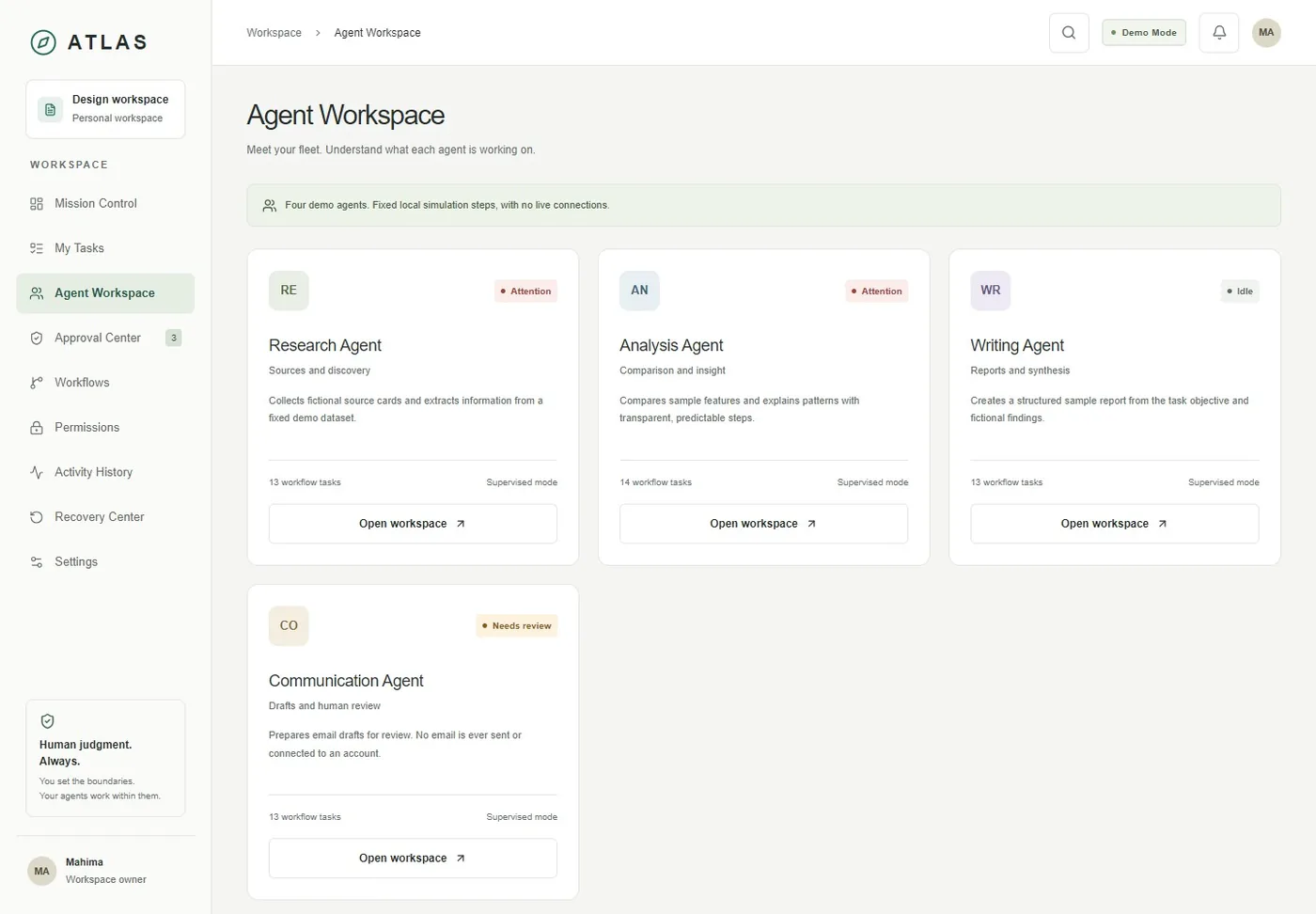
Agent WorkspaceWhich specialists are participating?
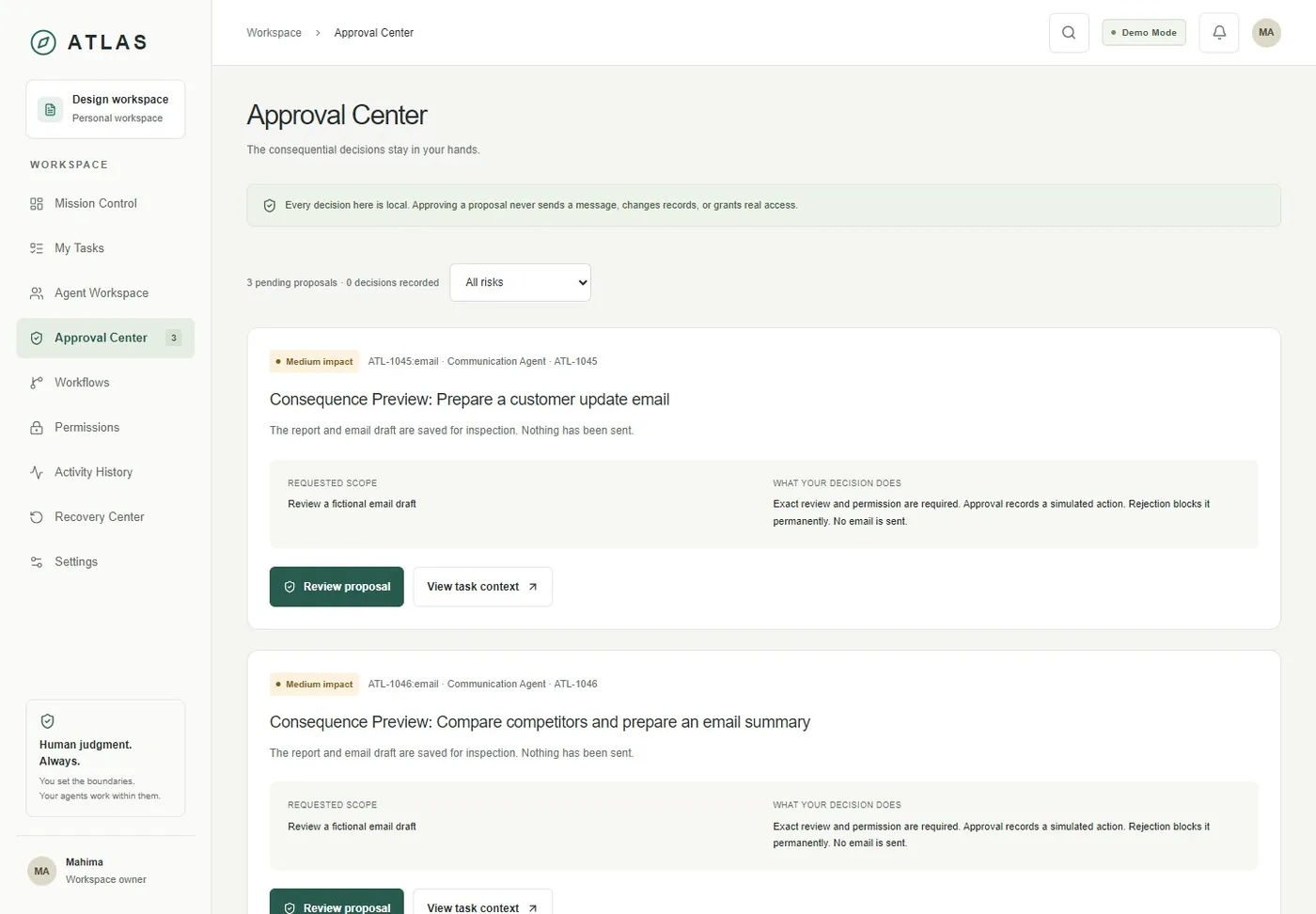
Approval CenterWhat needs my decision?
WorkflowsWho owns each stage, and what does it depend on?
PermissionsWhat may this task do?
Activity HistoryWhat happened, when, and under whose name?
Recovery CenterWhat stopped, and what survived?
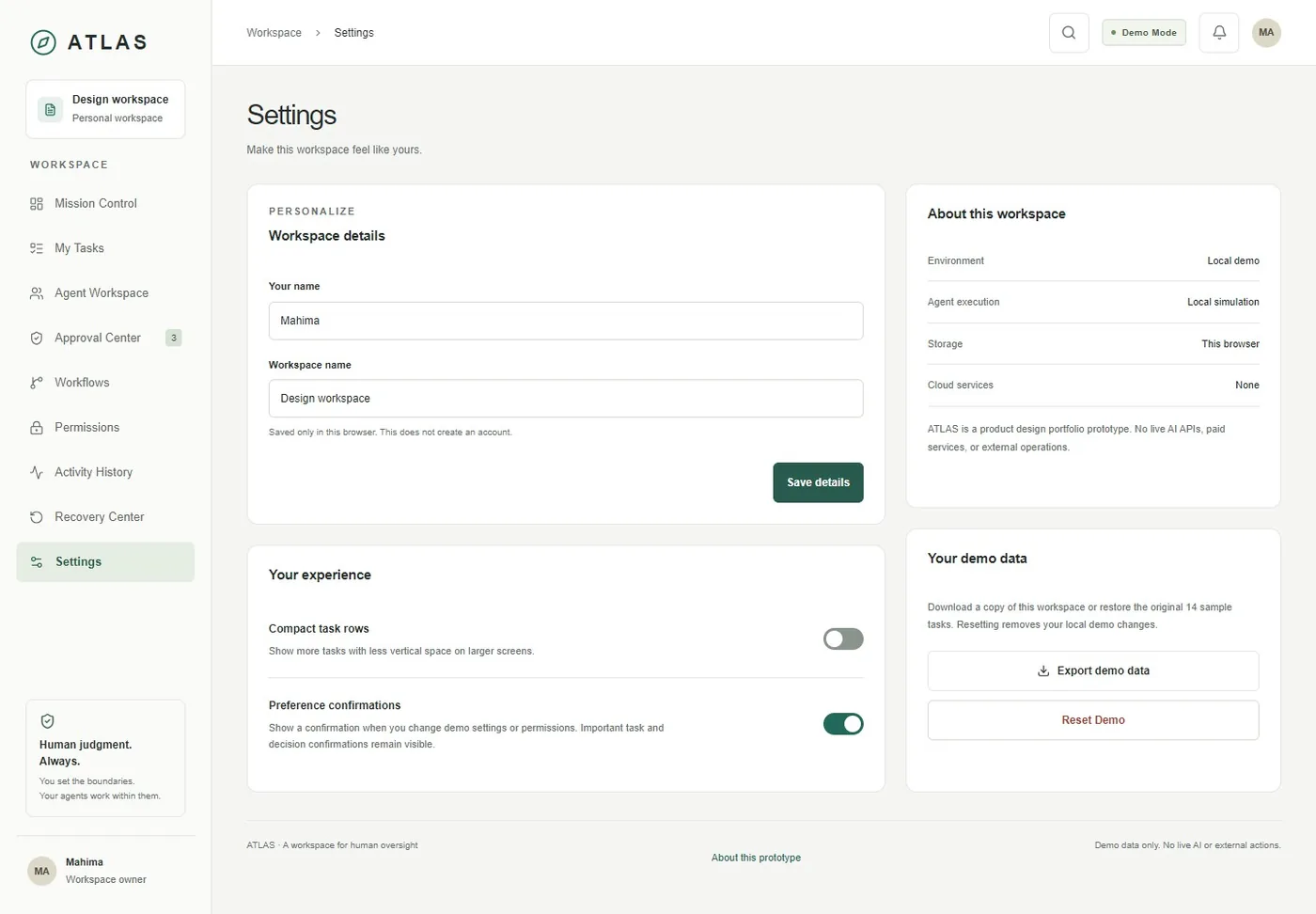
SettingsHow do I manage local preferences and saved demo data?

The core flow

01
1 / BriefObjective, context, tools and task boundaries.
02
2 / Plan reviewInspect the plan; request a human gate if needed.
03
3 / ExecutionFive fixed stages, owned by four specialists.
04
4 / Exact-action reviewReview recipients, payload and consequences.
05
5 / RecordSave the decision, exact payload and artifacts.

Exception paths: pause > inspect > resume; failure > inspect saved work > eligible retry; denial > resolve the boundary > eligible retry. Rejection and cancellation stop future work while retaining prepared outputs.

08 / Solution: delegation

Make the plan inspectable.

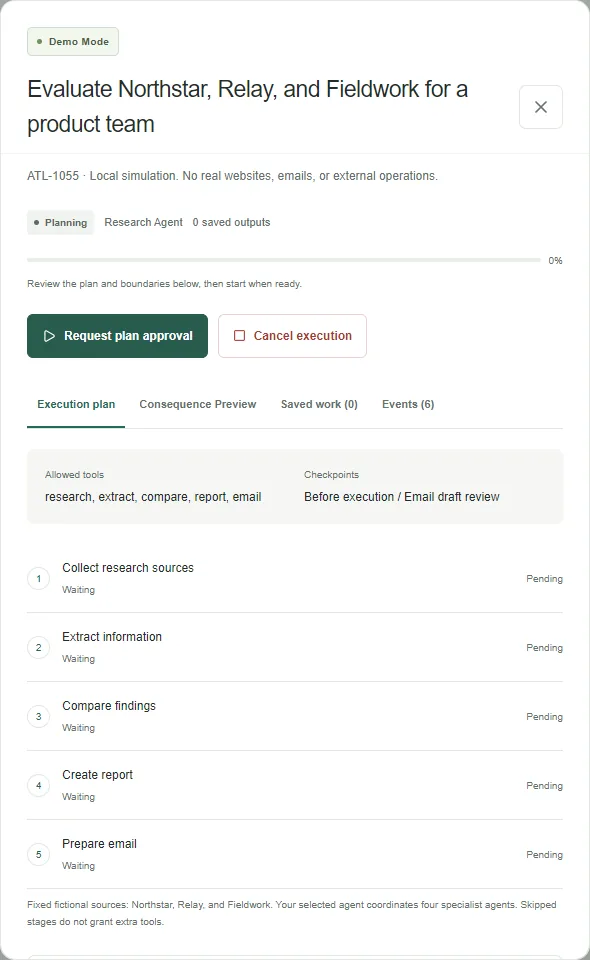
Setup captures the objective, context, coordinating agent, tools and checkpoints.

The pipeline stays fixed and entering a different objective does not create a new AI-generated plan.

The optional before-execution gate holds the run until the user approves it.
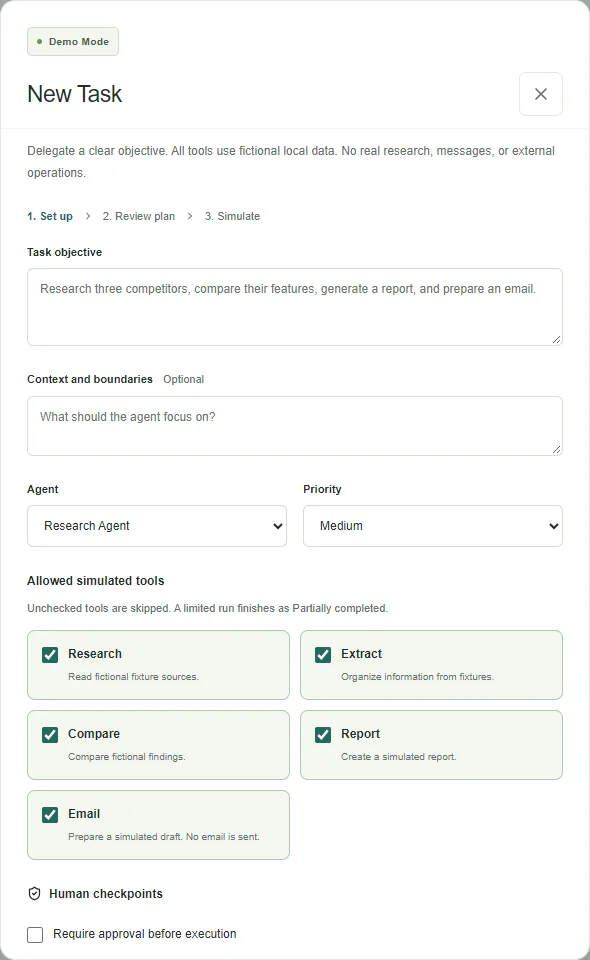
Setup: choose tools and an optional plan checkpoint. Detail crop; Demo Mode retained.
Plan: five stages remain pending before execution. Detail crop from the guided scenario.

Why: the user can examine scope before work advances.

Trade-off: the fixed plan demonstrates checkpoints, but cannot establish whether people would detect a bad plan generated by a real model.

09 / Solution: supervision

Show who is doing the work.

Workflows exposes stage ownership, dependencies and saved outputs.

Research Agent owns both research and extraction, so four specialists produce five stages.

Users can inspect each stage through a graph or a list backed by the same task data.
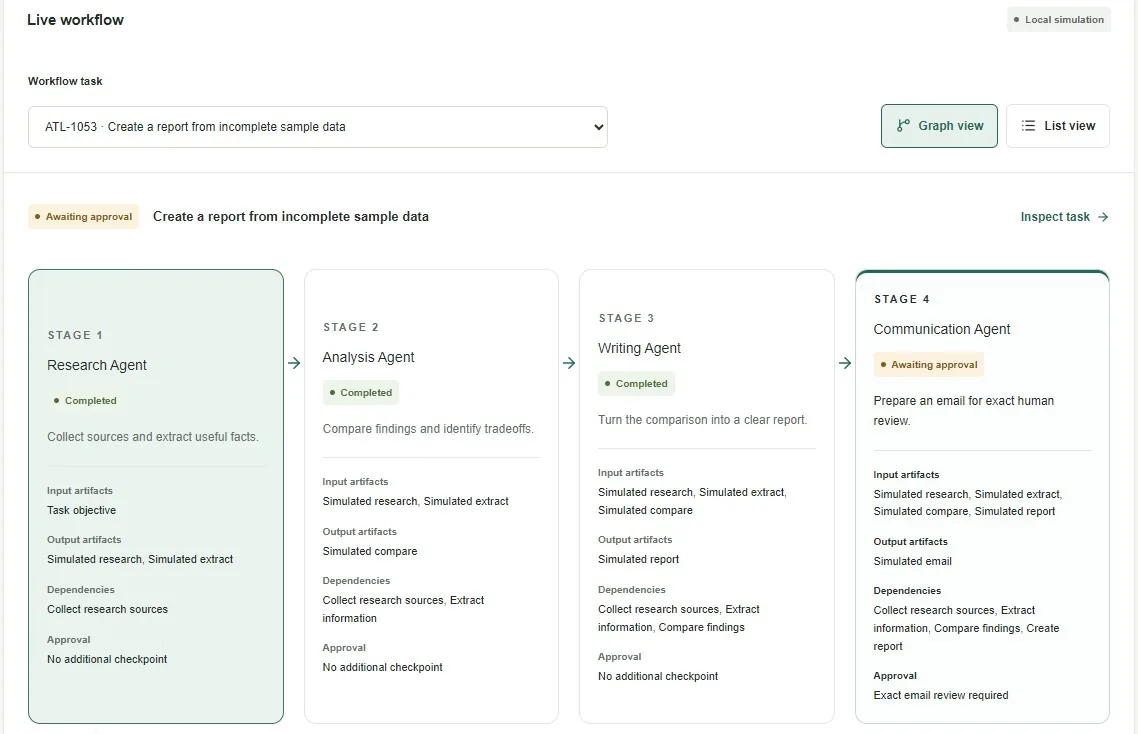
Workflow detail. In this captured task, the early stages are complete and communication awaits review. The outlined card indicates selection.
SpecialistResponsibility
Research AgentCollect fictional source information and extract notes.
Analysis AgentCompare the extracted information.
Writing AgentPrepare the report.
Communication AgentPrepare the draft and hold it for exact-action review.

Why: ownership helps explain a stopped task.

Trade-off: a graph adds visual complexity, so the list offers another way to inspect the same dependencies.

10 / Solution: task states

Prepared is not approved.

A progress bar answers how much selected work is prepared.
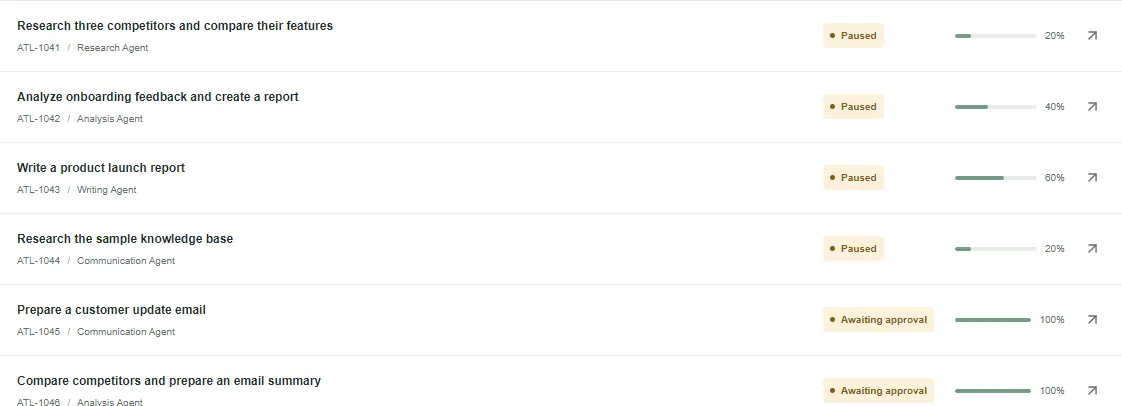
My Tasks detail: all work can be prepared while the final action still awaits approval.
StateWhat it means / what happens next
DraftThe brief exists; planning has not started.
PlanningThe fixed stages are available to inspect or submit for plan review.
Awaiting approvalA requested plan gate or mandatory exact-action gate holds execution.
RunningThe next selected, permitted stage can advance.
PausedExecution is held until the person resumes.
FailedAn error or denial stopped progress; inspect saved work and retry eligibility.
CancelledFuture work is stopped; existing outputs remain.
Partially completedPrepared work remains after omitted tools or rejection.
CompletedThe run has finished and its required decisions are resolved.
11 / Solution: consequence preview

Approve this. Exactly this.

Consequence Preview brings together the agent, parent task, affected resource, all recipients, exact subject and body, shared data, possible consequences, reversibility and required permission.

The default email has eight demo recipients.
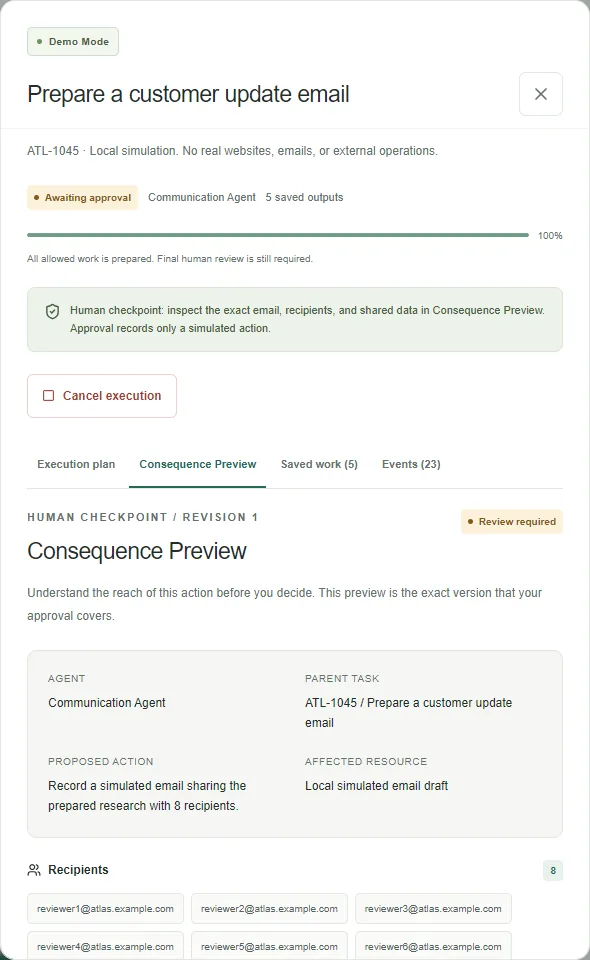
Context and recipients, at the top of the proposal. Detail crop; lower recipients continue in the scroll area.
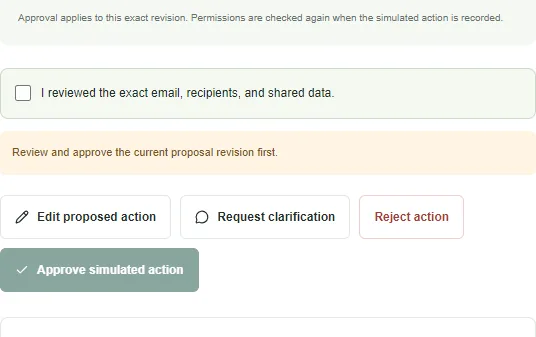
Decision-area crop: the review box and disabled approval control.

The decision rules

Review the current revision.Approval stays unavailable until its exact-review box is checked.
Check current permission.Enabling communication does not bypass exact approval.
Explain reversibility.A real email could be forwarded and cannot reliably be recalled. This demo sends nothing.

Why: a specific decision can be explained and recorded later.

Cost: completeness makes this a long review and a checkbox records acknowledgment. It cannot prove comprehension or prevent approval fatigue.

12 / Solution: decision branches

A new draft needs a new yes.

Changing the subject, body or recipients creates a new revision and clears both review and approval.
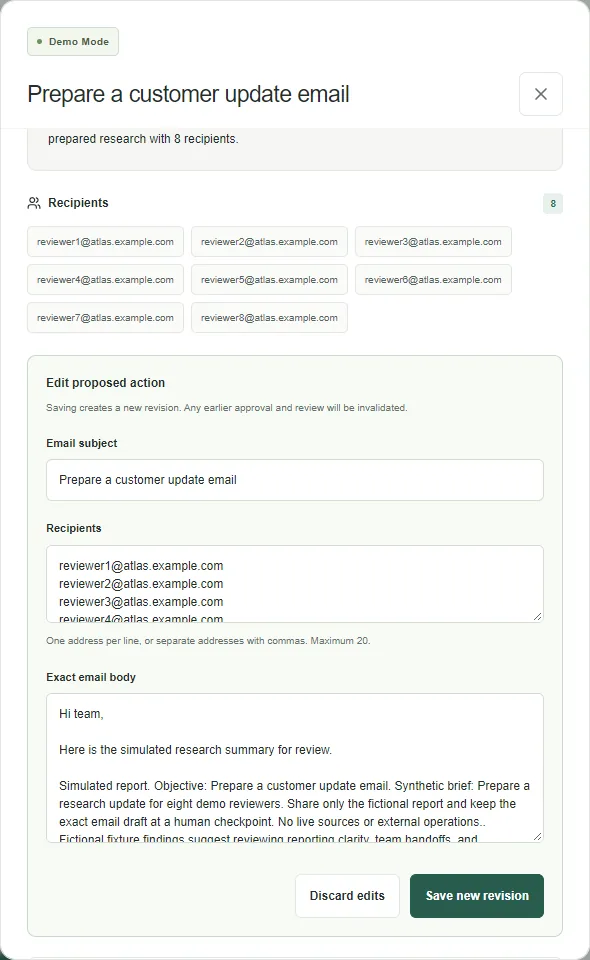
Edit the proposal: subject, recipients and body are editable. Saving creates a new revision with no inherited review or approval.

Clarification holds the action

Resolving the question returns the proposal to fresh exact review. It does not authorize communication.
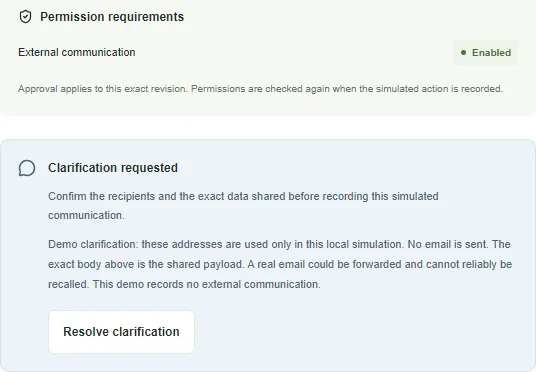
Local simulation / clarification detail.

Rejection ends the request

Prepared work survives. The rejected action cannot execute or be edited around the decision.
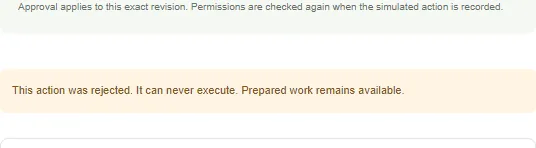
Local simulation / rejection detail.
The earlier decision stays intact.

If a previously approved draft is edited, its old payload remains in history. The new proposal needs its own review and approval.

13 / Solution: autonomy boundaries

Permission is not consent.

Permission answers what a task may attempt. Approval answers whether this exact consequential action may proceed.
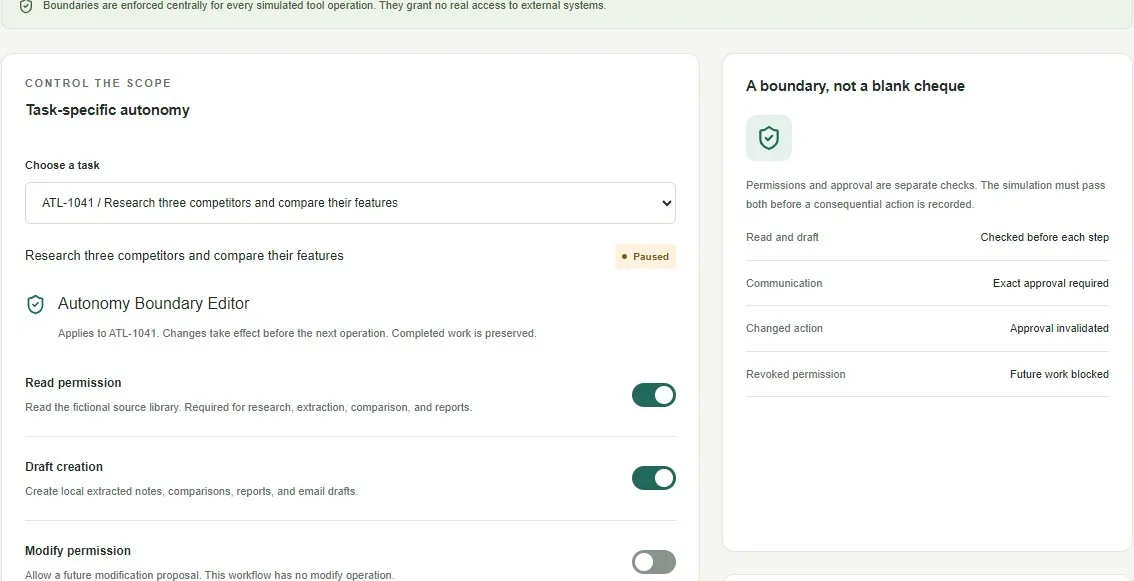
Permissions overview crop. Boundaries belong to the selected task; the complete permission model is summarized below.
BoundaryCurrent prototype behavior
Read permissionAllows fictional fixture reading; denial can stop a read step.
Draft creationAllows preparation of local notes, comparisons, reports and drafts.
External communicationRequires current permission plus exact revision review and approval. Records a simulation only.
Modify / Delete / Paid actionStored settings for future scope. The current pipeline does not implement these Operations and they remain blocked even when enabled.

Every future operation checks current boundaries. Revocation blocks the next affected step and preserves earlier work. Restoring the required boundary can make a failed step eligible for retry.

Trade-off: unsupported switches communicate the broader model but may imply capabilities the prototype lacks. I would test that interpretation before expanding the permission set.

14 / Solution: failure recovery

Resume from the break.

A failure should reveal what stopped and what remains available before offering another attempt.

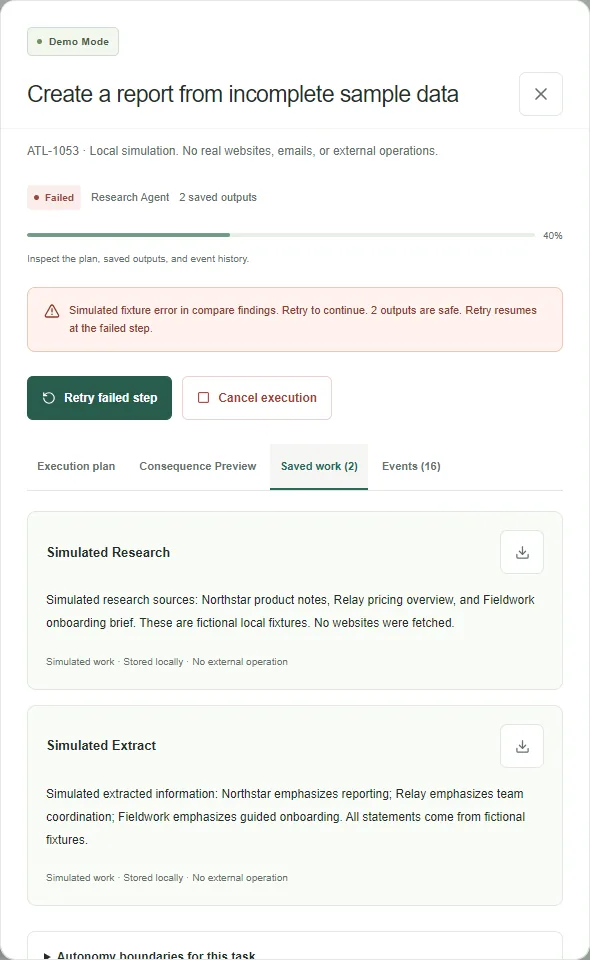
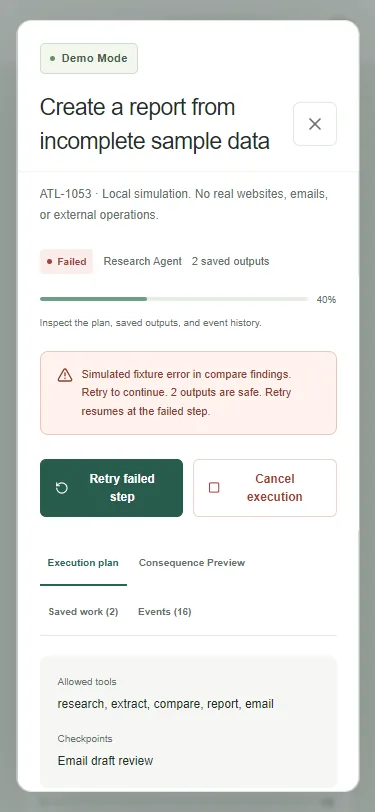
  • The comparison-error scenario stops after research and extraction.
  • The task is Failed with two saved artifacts.
  • Recovery Center exposes the failed stage, retained work and retry eligibility.
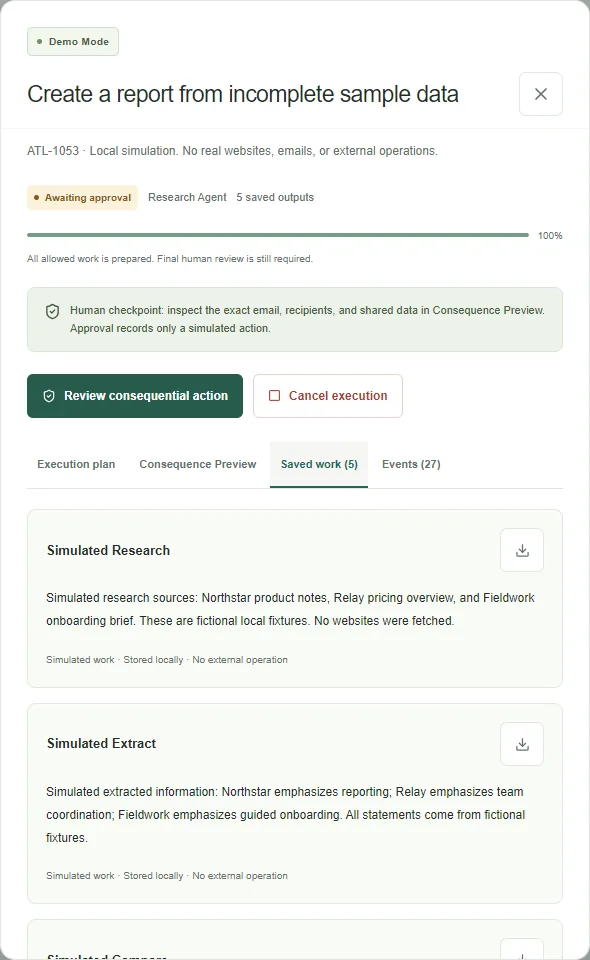
  • An eligible retry continues at comparison without duplicating earlier outputs.
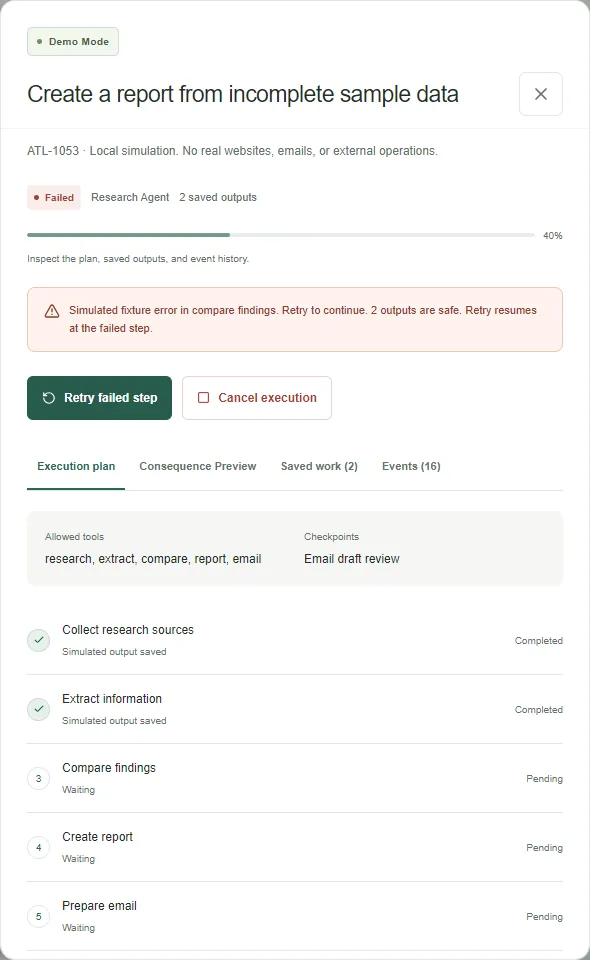
1 / Failure. Comparison stops. Two earlier outputs remain available.
2 / Inspect. Saved research and extracted notes can be inspected before retry.
3 / Retry. Five outputs are prepared. Exact-action review is still pending.
Recovery has conditions.

A permission, dependency or fixed simulation limit can keep retry blocked. A retry button is only useful when the next attempt is allowed to proceed.

Why: preserved artifacts make recovery inspectable.

Limit: these are local fixture outputs. The prototype does not resolve changed external data, duplicate real-world side effects or uncertain partial execution by a live agent.

15 / Solution: history & saved work

Give the decision a receipt.

Activity History is the Agent Flight Recorder. Task filters narrow the record - event details explain plans, attempts, denials, edits, decisions and retries. Approved payloads remain saved as snapshots, so later edits do not overwrite what was previously approved.
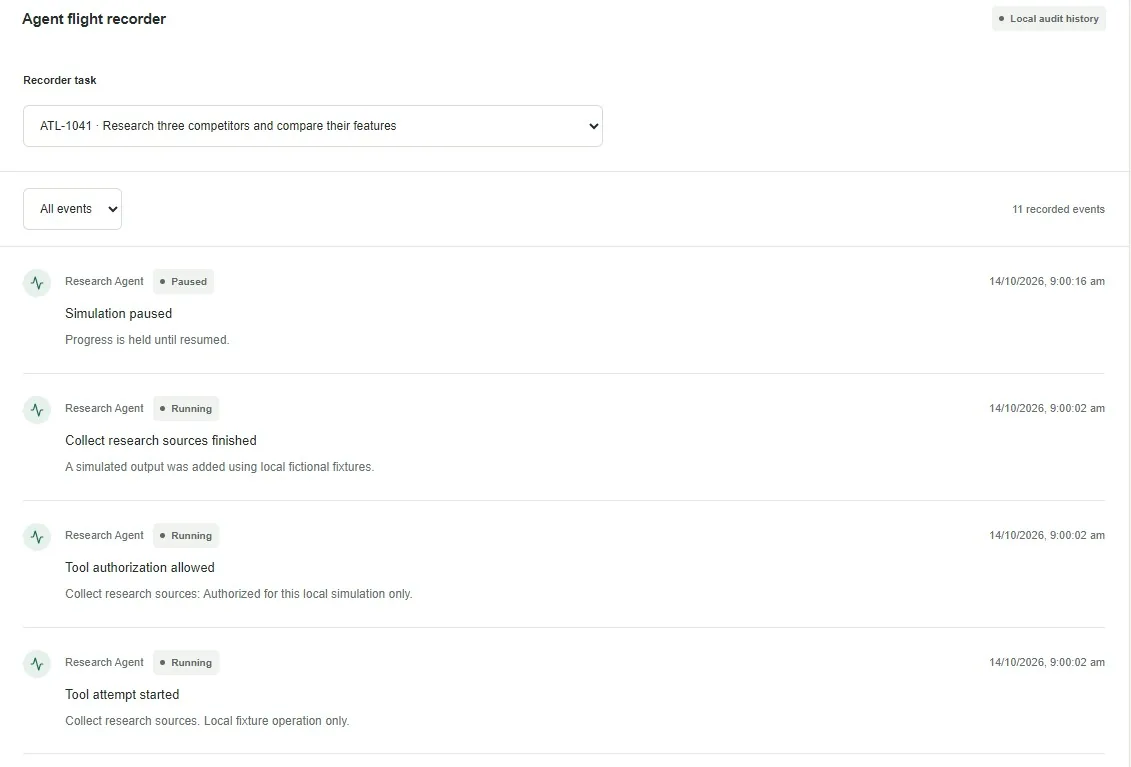
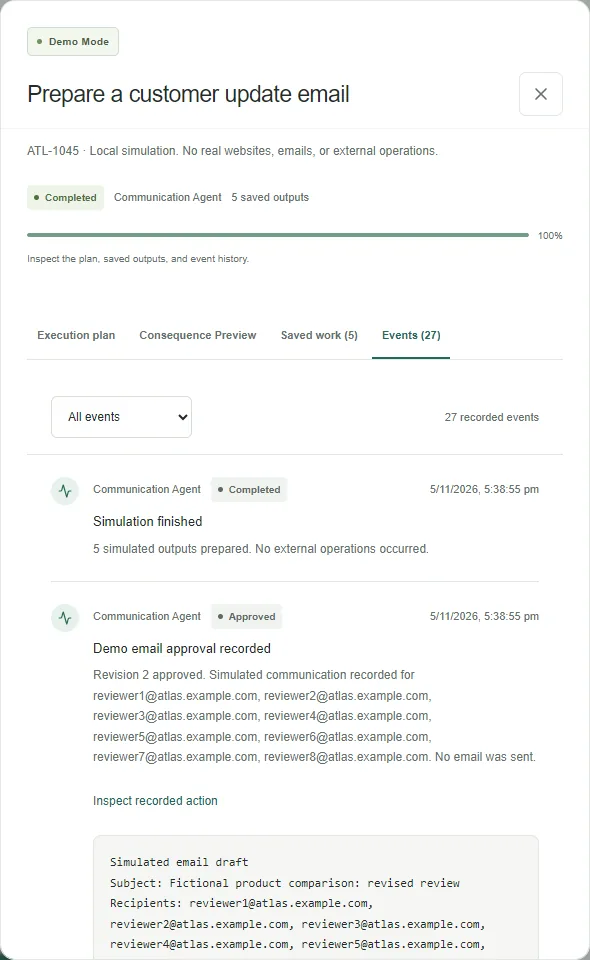
Activity History overview crop. This is a separate sample task, illustrating attributed events and filters.
Saved work travels with the task.Outputs remain inspectable and downloadable after failure, rejection or cancellation. They are marked as simulated.
A useful limit.The log lives in browser storage. It is inspectable product behavior, not a tamper-proof organizational audit trail.
Task history detail. The earlier exact approved payload is retained beneath its event.

Why: supervision needs both the current state and the explanation of how it got there.

Trade-off: a full log can overwhelm; filters and payload disclosure keep the overview compact while retaining detail.

16 / Solution: the supporting screens

Keep the rest of the workspace useful.

The supporting views make the core supervision flow easier to discover and return to.
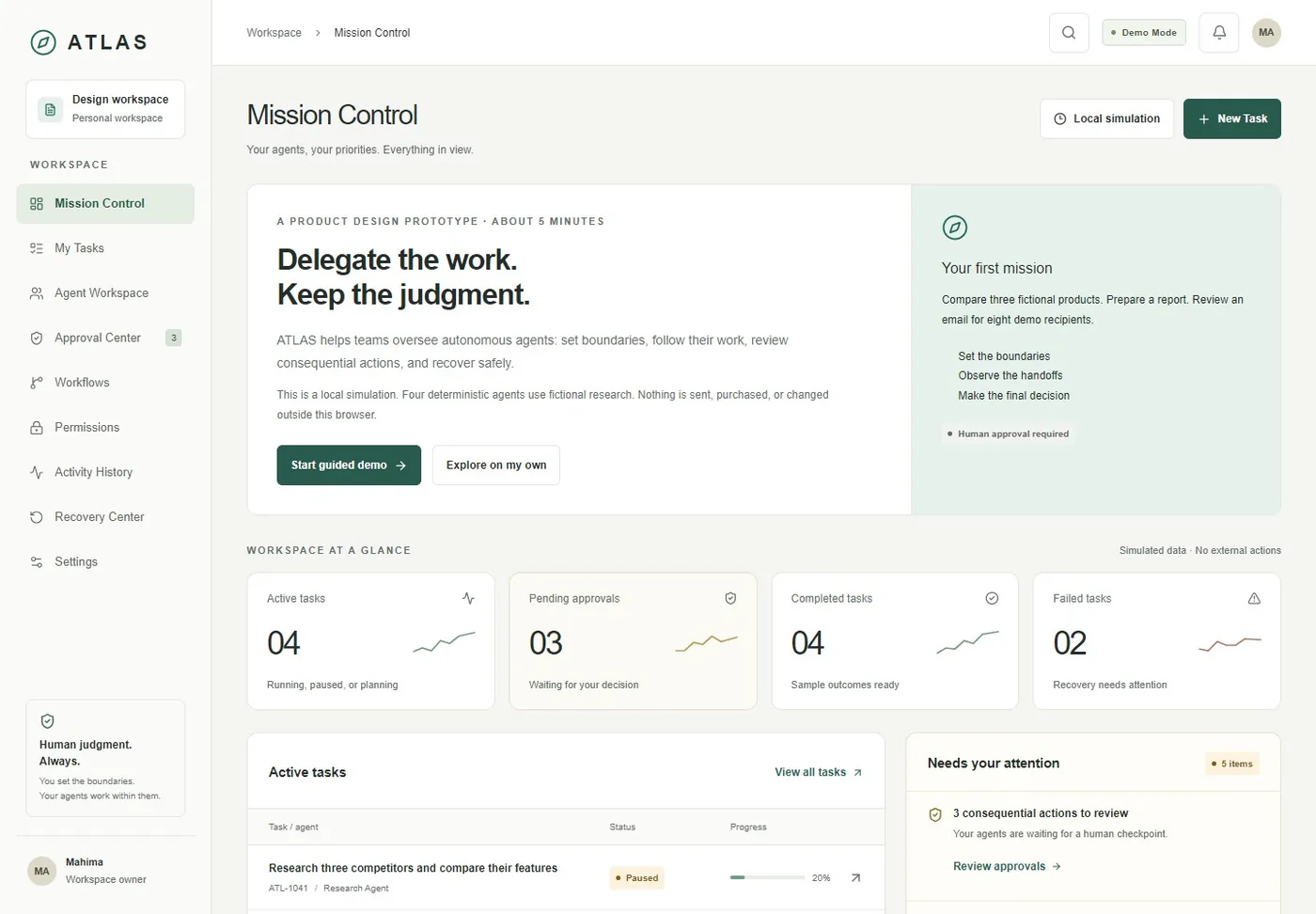
Onboarding. Optional introduction explains the simulation and starts a guided mission.
Agent Workspace. Specialist cards lead into participating tasks and stage ownership.
Approval Center. A dedicated queue keeps pending human decisions discoverable.
Settings. Local preferences, data export and a confirmed reset stay accessible.

Estimated resources and persistent guidance

Resource monitors show labeled estimates and fixed local simulation limits, not measured model usage or charges. The guided mission follows actual task state and survives refresh; unfinished or cancelled steps do not gain completion checkmarks.

17 / Visual system & accessibility

Quiet surfaces. Explicit signals.

The visual system keeps attention on decisions: off-white canvas, white panels, charcoal text and restrained sage accents.

Canvas
Surface
Text
Focus / accent
Warning

System fonts, shared spacing and 12px card corners create consistency. Status badges include words as well as color. Amber identifies review or warning states; it does not replace an explanation.
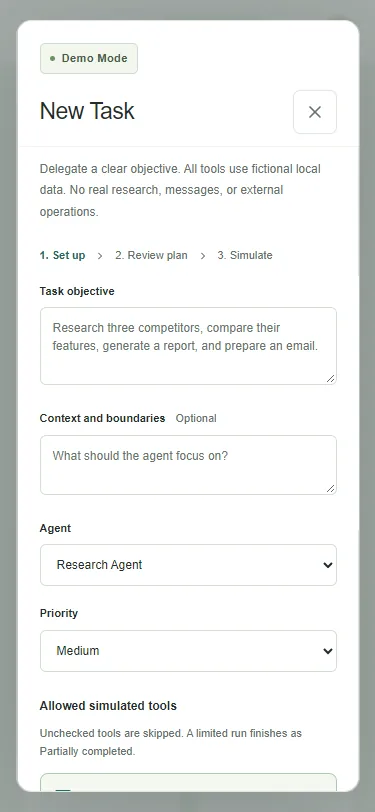
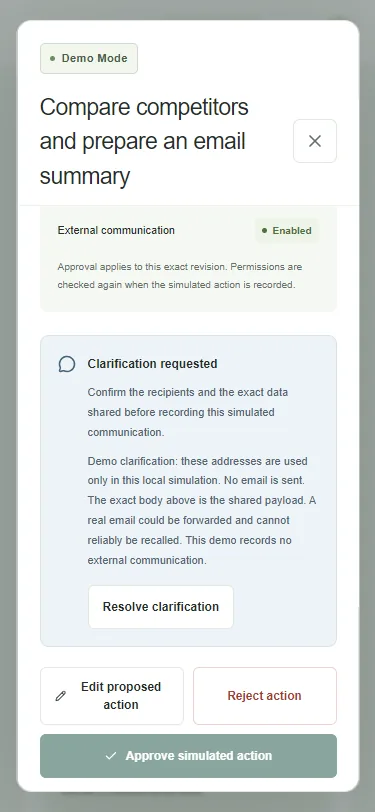
Delegate / 375px demo capture.
Clarify / 375px demo capture.
Recover / 375px demo capture.

Mobile. Navigation becomes a menu. Content stacks; task inspection, exact review and recovery remain available.

Access is part of the interaction model

The prototype includes labeled controls, a skip link, visible focus, dialog focus handling, text statuses, reduced-motion support and a workflow list alternative. Documented checks covered keyboard behavior and reflow at narrow widths.

Still to validate:

real screen reader use, actual browser zoom and sessions with disabled participants. Automated scans reported zero violations only in the states checked; this is not a WCAG conformance claim.

18 / Evaluate: iteration & checks

The audit changed the product.

These are documented implementation and interaction fixes.

Issue foundChange and supporting check
Fleet status named the coordinator while another specialist owned the active stage.Attributed status and participating tasks to the responsible specialist. Covered by ownership tests.
A stale browser tab could overwrite a task created elsewhere.Read the latest saved workspace before updates and allocate unique task IDs. Provider regression checks preserved both tasks.
Clarification copy called every entered address fictional.Changed it to explain that addresses are used only in the local simulation. Retested with an edited address.
Small controls and an unreachable short-window sidebar profile.Raised checked action targets to 44px and made the sidebar scrollable. Browser measurements confirmed the checked behavior

What the recorded checks establish

Engine and storage:revision-specific approval, denial, rejection, cancellation, dependency order, artifact preservation and saved-state behavior.
Browser journeys:setup, plan review, exact review, edits, clarification, recovery, navigation, exports and responsive states.
Build checks:lint, TypeScript and production compilation passed in the recorded runs.
19 / Outcome & next validation

A working oversight model. A user-value hypothesis.

The prototype connects nine screens, four simulated specialists and five fixed stages. It preserves task state across refresh, holds consequential actions for exact approval and retains earlier outputs during recovery. No usability improvement, adoption lift or business result was measured.

What I would test next

I would run an initial six to eight moderated sessions with intended product and operations users who already delegate multi-step work. This would be a formative study to locate misunderstandings, not a statistically representative performance benchmark.

Task / hypothesisWhat I would observeWhat would prompt a change
Delegate and review a plan. Visible scope supports prediction.Ask the person to explain what will happen next before execution.They miss a selected tool or misunderstand an optional checkpoint.
Inspect an email with a planted discrepancy. Exact review supports informed consent.Record whether they notice an unexpected recipient or changed content, without prompting.They approve despite missing the discrepancy.
Edit, clarify or reject a proposal. The branches have distinct meanings.Ask whether an older approval authorizes the new revision and what the current action may do.They expect automatic approval or continued execution after rejection.
Recover from comparison failure. Retained work supports recovery.Observe whether they find the two saved artifacts and retry at the failed stage.They restart unnecessarily or expect blocked retry to work.

I would report actual participant counts, observed errors, interventions, task completion and comprehension in the study context, alongside the design changes they led to. Timing would be descriptive at this sample size. A later comparison would be needed to claim improvement over another approach.

20 / Reflection & sources

The interface can hold a boundary. People still have to understand it.

ATLAS moved my attention from the output alone to the contract around it: what was permitted, what was reviewed, what changed and what survives. The most useful documented correction was ownership. A polished status card still misleads if it names the wrong specialist.

My next design priority is the density of exact-action review, especially on mobile. I would test information order and disclosure while keeping recipients, changed content and consequences visible enough to support a deliberate decision.

What production would require

Browser storage can be cleared; closing the browser stops the simulation. Real execution needs authenticated identity, server-enforced permissions, durable jobs, secure integrations, reliable handling of repeated actions, and retained audit records. Dynamic plans introduce uncertainty the fixed pipeline does not test.

Secondary sources

[1] Amershi et al. / Guidelines for Human-AI Interaction / CHI 2019

[2] Google PAIR / People + AI Guidebook / Feedback + Control

[3] NIST / AI RMF 1.0 / Appendix C / 2023

Next up Lineage

Creative Lineage Canvas - Recover the shadow. Keep the progress.

Read it All five projects
Atlas · tutorial